Bringing Drones Into a Country — What Each Destination Requires
What's allowed, limited, or prohibited for a drone in every destination we've verified, cited to each country's own customs authority.
- Australia
- allowed, within limits — No registration, licence or accreditation is required for recreational drone flying in Australia at any weight, but standard operating conditions apply: fly no higher than 120m, stay at least 30m from other people, and drones 250g or heavier can't be flown within 5.5km of a controlled airport.
Foreign-registered drones can't be separately registered in Australia, but that only matters for commercial operation — casual recreational tourist flying doesn't require it.
Checked 2026-09-16 — Civil Aviation Safety Authority (CASA) — Drone rules
- Brazil
- depends on specifics — Drones over 250g must be registered with Brazil's civil aviation authority (ANAC) through the SISANT system, which requires a Brazilian CPF or CNPJ taxpayer number — the real obstacle for tourists, who would need to obtain a CPF from a Brazilian consulate beforehand or have a Brazilian resident register the drone on their behalf. Drones of 250g or under don't need registration for recreational use, but must still follow altitude, visual-line-of-sight and people-distance rules.
A direct fetch of ANAC's registration page was blocked by a CAPTCHA in this pass, so this is drawn from consistent secondary reporting rather than the primary page's own text — treat the CPF/CNPJ barrier as the well-corroborated headline fact, but re-verify against ANAC directly before treating exact figures as final.
Checked 2026-09-16 — ANAC (Agência Nacional de Aviação Civil) — Cadastro de Drone (SISANT)
- Canada
- depends on specifics — Drones weighing 250g and above must be registered to fly in Canada — but foreign pilots cannot register directly. Instead, a visitor must apply for a Foreign SFOC-RPAS (Special Flight Operations Certificate) from Transport Canada before travelling, which takes about 30 business days to process for non-commercial use. Drones under 250g are exempt from both registration and the Foreign SFOC-RPAS requirement (except at advertised events).
Most consumer camera drones (e.g. a standard DJI Mini is one of the few common models under 250g; most other popular models are well above it) fall into the registration-required category, making the 30-business-day advance application a real, easy-to-miss trap for a short trip — a tourist who decides to bring their drone a week before departure will not receive approval in time. Transport Canada's own drone-pilot certificate is also required, separate from the SFOC-RPAS application.
Checked 2026-09-16 — Transport Canada — Getting permission to fly a drone in Canada as a foreign pilot
- China
- depends on specifics — "民用无人驾驶航空器所有者应当依法进行实名登记" ("Owners of civil unmanned aircraft shall carry out real-name registration in accordance with the law") — Art. 10 of China's Interim Regulation on the Administration of Unmanned Aircraft Flights, in force since January 1, 2024. This real-name registration requirement applies to all civil drones regardless of weight.
Bringing a personal consumer drone through Chinese customs is not itself restricted or specially declared. The registration requirement, however, is a genuine barrier for visitors in practice: the regulation doesn't spell out a foreign-operator registration path, and the platform is understood to require a Chinese phone number, which blocks straightforward tourist self-registration.
Checked 2026-09-16 — State Council / Civil Aviation Administration of China (CAAC) — Interim Regulation on the Administration of Unmanned Aircraft Flights, Art. 10
- Cyprus
- depends on specifics — Bringing a drone is not restricted, but flying it is regulated under EU (EASA) rules. Visitors from outside the EU who have not flown in another EU country before must register as an operator with Cyprus's Department of Civil Aviation (age 18+, €15, VISA card only) and attach the operator registration number to every drone. Registration is needed if the drone weighs more than 250 g, or has a camera or other sensor able to capture personal data. Non-EU residents also need an A1/A3 remote pilot certificate (online training and exam, €15, valid 5 years) — not required for a C0 drone under 250 g. No flying in no-fly zones and keep at least 8 km from airports and heliports.
If you already registered in another EU country (where you first flew), do not register again in Cyprus.
Checked 2026-10-02 — Cyprus Department of Civil Aviation — Unmanned Aircraft (drones.gov.cy)
- Egypt
- depends on specifics — Remote-controlled/radio-controlled aircraft (drones) require prior clearance from the competent control authority (the source names the Ministry of Defence, وزارة الدفاع, as an example) before Customs will release them.
The Egyptian Customs Authority's restricted-goods examples list "الطائرات الموجهة لاسلكيا" (radio-controlled aircraft) as requiring control-agency clearance. No further detail (e.g. a specific permit process, fee, or weight-based exemption) was found on a primary source in this pass — apply for clearance in advance rather than assuming a drone can simply be carried through Customs.
- Georgia
- depends on specifics — Georgia’s Civil Aviation Agency drone portal uses the EU-style class system (class C0: MTOM under 250 g; C2: under 4 kg; C3/C4: under 25 kg), asks users to "label your unmanned aircraft with your user registration number before heading out to fly", limits several classes to "a maximum attainable height above the take-off point limited to 120 m", and states that "Flying UAS within Restricted, Prohibited and Dangerous areas without authorization is not permitted" (zone information at airspace.gov.ge).
The official portal page does not say who must register, or whether a foreign visitor can register or fly a drone brought from abroad; secondary sources say drones over 250 g need GCAA registration but that is unconfirmed here. Customs also treats high-frequency radio-electronic devices and communication equipment as permit goods (Revenue Service brochure) — whether that reaches consumer drones is not stated. Register or check with the Civil Aviation Agency before flying.
Checked 2026-09-21 — Georgian Civil Aviation Agency — UAS (drone) portal
- Hong Kong
- depends on specifics — Under Hong Kong's Small Unmanned Aircraft Order (Cap. 448G), "all SUA and remote pilots shall be registered except for Standard Category A1 Operations" — that is, aircraft weighing not more than 250 g operated within the applicable operating requirements are exempt from registration. Non-residents register through the Civil Aviation Department's eSUA portal using their travel documents; registrations by non-residents "are normally valid for six months."
Visitors are told to apply once they have concrete travel plans and their travel documents ready; registration labels are collected in person, through an authorised representative, or delivered by local surface mail to a Hong Kong address (no international courier). Anything over 250 g should be registered before you fly it, so plan ahead rather than sorting it out at the airport. The page excerpt read here doesn't detail the heavier categories' operating rules or insurance requirements.
Checked 2026-09-21 — Civil Aviation Department (Hong Kong) — Small Unmanned Aircraft Order (Cap. 448G): tips for visitors
- India
- prohibited — Import of drones (Unmanned Aircraft Systems) in Completely-Built-Up (CBU), Semi-Knocked-Down (SKD), or Completely-Knocked-Down (CKD) form is classified "Prohibited" under India's ITC (HS) 2022 import policy (Chapter 88, Policy Condition No. 03, as revised by DGFT Notification No. 54/2015-20 dated 9 Feb 2022). The only stated exceptions are: (i) government entities, government-recognised educational/R&D institutions, and drone manufacturers importing for R&D, each requiring a DGFT import authorisation; and (ii) drones for defence and security purposes, also requiring DGFT authorisation. Import of drone components (not assembled units) is classified "Free".
No exception for tourists or personal/recreational use is stated anywhere in this notification — a foreign visitor's personal camera drone falls squarely within the prohibited CBU category, with no realistic path to a DGFT import authorisation. This is a genuinely high-risk item: many travelers assume a personal drone is fine to pack, and India's rule is stricter than most destinations already in this dataset.
Checked 2026-08-13 — Directorate General of Foreign Trade — Notification No. 54/2015-20 dated 9 Feb 2022, ITC (HS) 2022, Chapter 88 Policy Condition No. 03 (import policy for Unmanned Aircraft Systems)
- Indonesia
- depends on specifics — Nationally, Indonesia doesn't restrict bringing a drone through customs and doesn't require registration or a licence for recreational flying of Open Category drones under 25kg, per Ministry of Transportation Regulation PM 37/2020. Bali is a documented exception: local reporting describes a 2025 directive requiring pre-arrival drone registration through the SIPP-TA/SIPUDI system for all drone weights before flying there.
The national regulation (PM 37/2020) is confirmed via Indonesia's official legal-database domains, though not read as full primary text in this pass. The Bali-specific 2025 registration directive is secondary-sourced only and should be treated as unconfirmed until a primary DGCA Indonesia document is found — don't assume it applies outside Bali.
Checked 2026-09-16 — Peraturan Menteri Perhubungan RI No. PM 37 Tahun 2020 — Pengoperasian Pesawat Udara Tanpa Awak di Ruang Udara yang Dilayani Indonesia
- Ireland
- depends on specifics — Flying a drone in Ireland that weighs more than 250 grams, or has a camera or sensor, requires registration as a drone operator with the Irish Aviation Authority (IAA). Registration costs €41 and is valid for 2 years; you then label the drone with your operator registration number and load it into the drone's Direct Remote ID. Drones over 250g also need online-training certification (valid 5 years). Open-category flights are for drones under 25 kg (or with a class mark 0–4); heavier drones cannot be flown without IAA permission. If you live in the EU you only register in your country of residence, not in each country you fly in.
This is a flight-operation rule, not a customs ban — bringing a drone into Ireland isn't itself restricted, but flying it legally is. The IAA or the Gardaí can take away a drone if they believe it is likely to be used in breach of the regulations, and flying a drone with a camera over identifiable people can raise privacy offences. The Citizens Information and IAA pages do not spell out a separate route for non-EU visitors who aren't registered in an EU state — confirm the process with the IAA (MySRS) before travelling rather than assuming registration can be done on arrival.
Checked 2026-09-21 — Citizens Information — Owning and operating a drone (summarising Irish Aviation Authority rules; IAA registration page: https://www.iaa.ie/general-aviation/drones/drone-register)
- Japan
- depends on specifics — Registration with Japan's Ministry of Land, Infrastructure, Transport and Tourism (MLIT) is mandatory for any drone weighing 100g or more, with no exemption for foreign visitors, in force since June 20, 2022.
In practice, MLIT's online registration system requires a Japanese address and typically takes 7-10 business days to process, which makes same-trip tourist registration impractical without advance planning through a local agent or rental company.
Checked 2026-09-16 — MLIT (Ministry of Land, Infrastructure, Transport and Tourism) — Unmanned Aircraft Registration System
- Kenya
- depends on specifics
Drones may not be imported into Kenya without a permit issued by the Kenya Civil Aviation Authority (KCAA) (Civil Aviation (Unmanned Aircraft Systems) Regulations, 2020, reg. 7(1)). Visitors can apply for a temporary permit, valid for operation of the UAS for up to 30 days and renewable once (reg. 11(1)). KRA's own restricted-items list separately confirms drones require authorisation before customs release. Apply to KCAA before travelling — do not assume a drone can simply be carried through customs.
Checked 2026-08-11 — Civil Aviation (Unmanned Aircraft Systems) Regulations, 2020 (Kenya Civil Aviation Authority)
- Malaysia
- depends on specifics — Under regulation 140 of the Civil Aviation Regulations 2016, anyone intending to operate an Unmanned Aircraft System must obtain prior authorisation from CAAM. For low-risk operations (visual line of sight, under 400 ft above ground, no spraying) that authorisation is an Authorisation to Fly (ATF) permit, applied for by email to drone.atf@caam.gov.my at least 14 working days before the flight; flying without the required permit is a violation penalised under regulation 206(3).
This is a flight-operation requirement, not a customs import ban. CAAM's notice says nothing about a tourist or recreational exemption, so plan on an ATF permit for any flight. Widely reported figures — a RM250 permit fee, registration of drones above 250 g, a RM50,000 maximum fine — appear only in secondary sources and were not confirmed on a CAAM page in this pass; whether importing a consumer drone needs a separate approval (e.g. radio-equipment certification) was also not confirmed.
Checked 2026-09-21 — Civil Aviation Authority of Malaysia (CAAM) — Safety Information 01/2025: Authorisation to Fly (ATF) application for UAS operations
- Maldives
- depends on specifics — Flying a drone needs prior approvals, reviewed "case-by-case" by the Maldives Civil Aviation Authority: "Depending on the area of operation, you may need approval from Maldives National Defence Force" (MNDF); "once approval has been obtained from MNDF, apply to the CAA" with the application form and a copy of the MNDF permit; plus "approval from any other relevant parties (e.g. resorts, island or city council)". Operations must stay below 400 feet. The airport operator's customs page: "Permits required in advance from MCAA + MNDF. Drones without permits may be held at customs."
This CAA page sets out the flying-permit procedure only. It does not say whether tourists or small recreational drones are exempt, how far ahead to apply, what the penalties are, or how customs treats a drone in luggage, so none of that is asserted from the CAA page. The airport operator's customs page adds: "Permits required in advance from MCAA + MNDF. Drones without permits may be held at customs", and lists drones without permits among items given a retrieval receipt at the border.
Checked 2026-09-21 — Maldives Civil Aviation Authority — Flying Remotely Piloted Aircraft (Drones) in the Maldives
- Mexico
- depends on specifics — "El registro de la información del RPAS debe llevarse a cabo antes de iniciar su operación correspondiente" (RPAS registration must be completed before beginning operation) — Mexico's Federal Civil Aviation Agency (AFAC) requires every drone to be registered under standard NOM-107-SCT3-2019 before it can legally fly, via the Apéndice K registration form (proof of ownership/possession plus identification), submitted by email to rpas@afac.gob.mx. A registration folio is issued within 10 business days.
AFAC's own page does not distinguish between Mexican residents and foreign visitors — the same standard and process applies to everyone, with no visitor exemption or simplified tourist path found in this pass. Bringing the drone itself into Mexico isn't restricted, but flying it without completing this registration in advance is.
Checked 2026-09-16 — Agencia Federal de Aviación Civil (AFAC) — RPAS/Drones, citing NOM-107-SCT3-2019
- Morocco
- depends on specifics — Drones are import-license goods, not ordinary duty-free personal effects. Morocco's Customs administration explicitly excludes drones and other remote-controlled flying objects from its duty-free children's-toys/personal-effects allowance. For a tourist's temporary stay, authorization is delivered by local DGSN (Sûreté Nationale) services; permanent import requires an import license from the Foreign Trade department, and equipment using radio transmission may also need ANRT (telecoms regulator) homologation.
The clearest primary citation found (a 2024 Moroccan Customs circular) is framed around the annual 'Marhaba' welcome campaign for Moroccans residing abroad, but its general-rules section (I.3, listing import-license goods and prohibited items) states rules of general application, not MRE-specific ones — treated as a valid general citation here. A dedicated foreign-tourist-specific drone circular was not located in this pass; re-verify with one if found. Secondary sources describe seizure and fines for unauthorized drone use, but no primary source for penalty amounts was fetched, so no penalty figure is published.
- New Zealand
- allowed, within limits — Unmanned aircraft under 25kg are covered by Part 101 of New Zealand's civil aviation rules. Visitors may fly without registering, holding a licence, or a certificate, provided they follow Part 101's standard conditions: daylight only, within visual line of sight, yield to manned aircraft, get consent before flying over people or their property, and obtain ATC clearance in controlled airspace.
New Zealand does not currently operate a drone registration scheme at all (one has been floated with no confirmed date) — this is a genuinely lighter-touch regime than most other destinations in this dataset.
Checked 2026-09-16 — Civil Aviation Authority of New Zealand — Part 101: Unmanned Aircraft and Rocket Operating Rules
- Nigeria
- depends on specifics — Drones weighing more than 250g must be registered with the Nigeria Civil Aviation Authority (NCAA), and operators need a Remotely Piloted Aircraft Systems Certificate plus a per-flight authorization before flying.
NCAA's advisory circular page is real and reachable, but its detailed procedural text lives in a linked PDF that wasn't retrievable in this pass, so the 250g threshold and certificate process should be treated as the general shape of the rule rather than a word-for-word confirmed figure — undeclared drones risk being held in bonded customs storage pending the paperwork.
Checked 2026-09-16 — Nigeria Civil Aviation Authority (NCAA) — Unmanned Aircraft System Operations in Nigeria's Airspace (Guidance NCAA-GAD-AC-002)
- Philippines
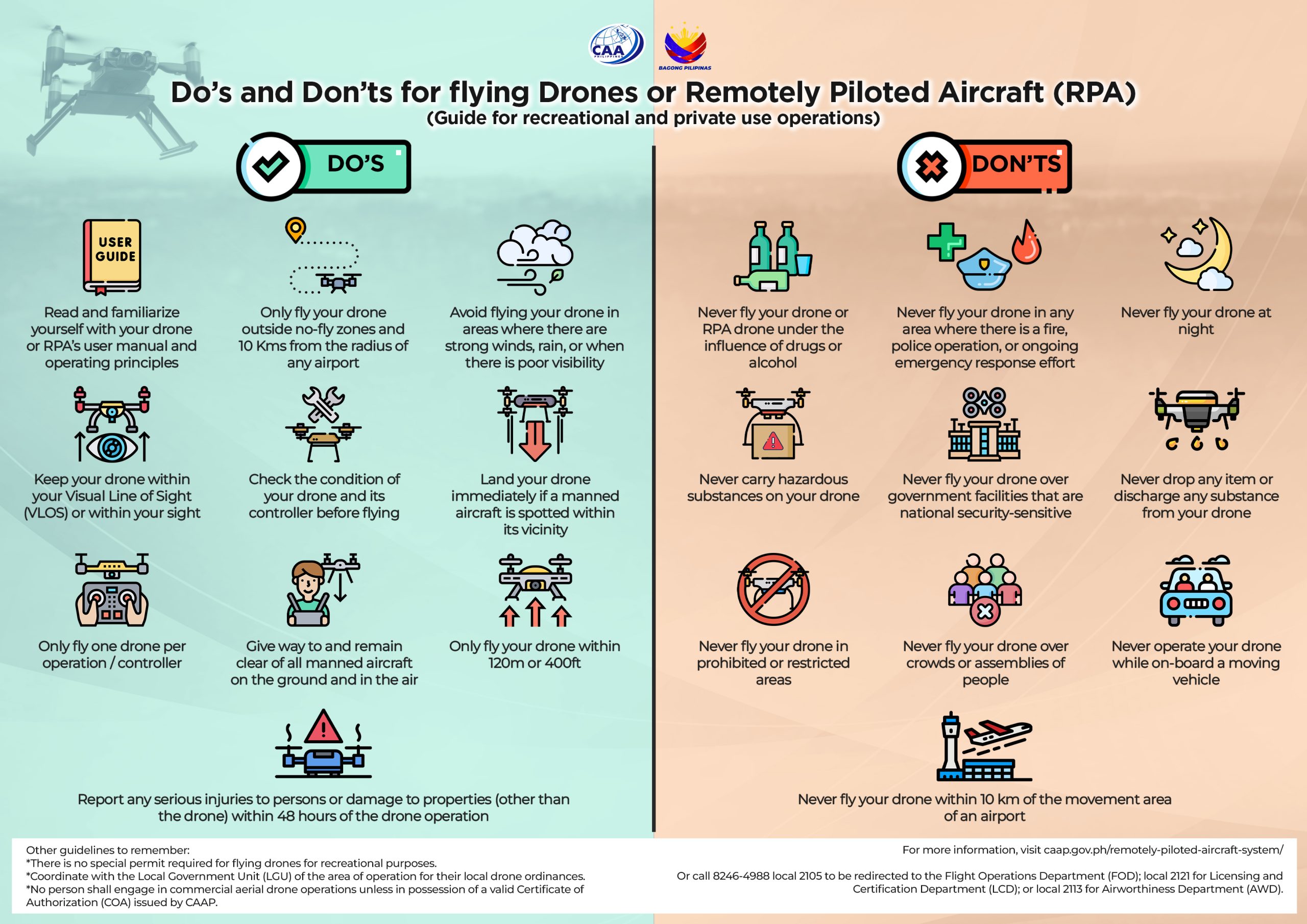
- allowed, within limits — The Civil Aviation Authority of the Philippines (CAAP) states plainly: "There is no special permit required for flying drones for recreational purposes." Operating rules apply instead of a permit: keep the drone within visual line of sight, stay at or below 120m/400ft altitude, stay at least 10km from any airport's movement area, don't fly at night, over crowds, over national-security-sensitive government facilities, or in any area with an active fire/police/emergency response. Travelers should also check with the Local Government Unit (LGU) of the area for local drone ordinances, which CAAP notes can add restrictions on top of the national rules.
A genuinely different, more permissive answer than most destinations checked for this category — Philippines has no registration or advance-permit requirement for personal/recreational drones, only in-flight operating rules. Commercial drone operations are separately gated behind a CAAP Certificate of Authorization (COA), which doesn't apply to a tourist's personal use.
Checked 2026-09-16 — Civil Aviation Authority of the Philippines (CAAP) — Do's and Don'ts for Flying Drones or Remotely Piloted Aircraft (RPA)
- Rwanda
- depends on specifics
Rwanda Civil Aviation Authority (RCAA) requires every drone to be declared to Rwanda National Police at the point of entry into the country ("Declare your drone to Rwanda National Police at any point of entry into the country, failure to abide calls for penalty as stipulated in the Regulations" — caa.gov.rw). Before operating (flying) the drone, RCAA also requires a UAS Activity Permit and UAS registration under Rwanda Civil Aviation Regulations Part 27. This is a real, concrete border-declaration requirement (stronger than most other destinations in this dataset, where only a general operational-permit gap was found) — do not attempt to bring a drone into Rwanda without declaring it and applying for the RCAA permits in advance.
Checked 2026-08-13 — Rwanda Civil Aviation Authority — Unmanned Aircraft (Drones)
- Saudi Arabia
- depends on specifics — ZATCA lists drones as one of its named examples of "restricted materials that require approval from competent authorities" (the other named example being medicines) — meaning a drone cannot simply be carried through like an ordinary personal item, but isn't outright banned either. Travelers must disclose the drone at customs and obtain the necessary authorisation before entry.
ZATCA's page does not name the specific competent authority or describe the approval process/timeline for drones (unlike its more detailed treatment of medicines, which points to the SFDA clearance system cited elsewhere on this site). Saudi Arabia's General Authority of Civil Aviation (GACA) is the plausible drone/UAV regulator, but that could not be independently confirmed against a primary GACA source in this pass — treat the approval requirement as confirmed, but the exact process as unconfirmed.
Checked 2026-09-14 — ZATCA (Saudi Zakat, Tax and Customs Authority) — prohibited and restricted items for travelers
- Serbia
- depends on specifics — Quoted directly from Customs: whether a permit is needed to import/export a drone "depends on whether it, in terms of its technical characteristics, meets the conditions prescribed in the National Control List of Dual Use Items and the National Control List of Weapons and Military Equipment." The permit, if needed, is issued by the Ministry of Internal and Foreign Trade. A list of UAV models exempt from the permit requirement exists in the Ministry's own "Instructions for the identification of UAV" document, which wasn't read in this pass.
This is a customs/export-control classification, not a flight-registration rule — it governs whether your specific drone model can cross the border with or without a permit, based on its technical specifications, not where or how you fly it once in Serbia. If your drone isn't clearly on the exempt list, Customs says to contact the Ministry directly for a classification opinion before travel.
Checked 2026-09-22 — Customs Administration of the Republic of Serbia — Passenger Customs Clearance FAQ (Tourists)
- Singapore
- depends on specifics — Drones over 250g must be registered through the Civil Aviation Authority of Singapore's (CAAS) UA Portal: a S$25 registration label plus online registration, using Singpass or a UAPass account for foreign visitors, taking about 5 working days to process. The minimum age to register is 16. Drones of 250g or under are exempt from registration for basic recreational use.
Confirmed directly from CAAS's own registration page, including the UAPass pathway specifically built for foreign visitors — apply before arrival, since the processing time doesn't support a same-day registration on landing.
Checked 2026-09-16 — Civil Aviation Authority of Singapore (CAAS) — Registration / Deregistration (Unmanned Aircraft)
- South Africa
- depends on specifics — "In accordance with Part 101.02.4(1) of the Civil Aviation Regulations, 2011, no remotely [piloted] UAS shall be operated within the Republic of South Africa, unless such UAS has been issued with a certificate of registration by the Director" (South African Civil Aviation Authority). This is a flight-operation registration requirement, not a customs import ban — bringing a drone into the country isn't itself restricted, but legally switching it on to fly is.
SACAA's own UAS guidance page does not address a visitor/tourist exemption, a temporary-registration path, or how a foreign-registered drone is treated — it describes private and commercial operator registration generally, with no carve-out found for short-stay travelers in this pass. Treat flying a personal drone in South Africa as requiring SACAA registration obtained in advance, not something sorted out on arrival; SACAA's own contact for this is rpasInbox@caa.co.za.
Checked 2026-09-16 — South African Civil Aviation Authority (SACAA) — Unmanned Aircraft Systems, citing Civil Aviation Regulations 2011, Part 101.02.4(1)
- South Korea
- depends on specifics — Drones under 250g are exempt from registration. Drones of 250g or heavier must be registered through the Drone One-Stop portal, a Ministry of Land, Infrastructure and Transport administrative system that lists a roughly 7-business-day processing time for aircraft registration.
The Drone One-Stop portal itself was reachable and confirmed real in this pass (Korean government domains have historically been unreachable from this environment, so this is a genuine access breakthrough), but its registration process requires Korean-resident identity verification with no stated tourist exemption or workaround — in practice this blocks visitors from registering anything 250g or heavier. The specific 250g threshold comes from secondary sources, not the portal's own text.
Checked 2026-09-16 — Drone One-Stop (드론원스톱 민원서비스) — Ministry of Land, Infrastructure and Transport drone administrative portal
- Taiwan
- depends on specifics — Drones with a maximum take-off weight over 250g must be registered with Taiwan's Civil Aeronautics Administration (CAA) before flying (Regulations of Drone, Art. 6(1)); drones under 250g owned by an individual are exempt from registration. Foreign nationals bringing their own drone face an extra step regardless of weight class for anything requiring registration: under Art. 38(1)-(2), they must submit documents to the CAA and can only fly "after CAA's certification," and a foreign visitor holding valid drone credentials from their home country can get that certification valid for "a maximum of six month after the date of issuance."
A tourist bringing a small recreational drone under 250g can fly without registering it at all, regardless of nationality. Operating a heavier drone (2-15kg with navigation systems, or anything over 15kg) also needs a Remote Pilot License with age/testing requirements on top of the registration/certification above — a materially higher bar than just registering the aircraft.
Checked 2026-09-22 — Laws & Regulations Database of the Republic of China (Taiwan) — Regulations of Drone, Arts. 6, 38
- Thailand
- allowed, within limits — Bringing a personal drone into Thailand in your luggage is allowed (no import permit needed for non-commercial personal use), but it cannot be legally operated until registered with both the National Broadcasting and Telecommunications Commission (NBTC, drone ownership/radio-frequency registration at anyregis.nbtc.go.th) and the Civil Aviation Authority of Thailand (CAAT, drone + pilot registration at uasportal.caat.or.th) — required for any drone with a camera, or weighing over 2 kg.
CAAT registration can take up to roughly 14 days and generally needs a Thai mobile number and an entry stamp already in the passport, which effectively blocks legal flight for short trips even though bringing the drone itself is not restricted. Liability insurance (THB 1,000,000 minimum third-party cover) is required for CAAT registration. This entry covers the import/registration question; it is not a customs duty-free allowance in the same sense as alcohol/tobacco.
Checked 2026-08-13 — Thailand.go.th (Royal Thai Government official information portal) — Updated Guide for Tourists Regarding Flying a Drone in Thailand
- Turkey
- depends on specifics — Drones under 500g are commonly described as exempt from registration, customs paperwork and Turkish ID requirements; drones 500g and over must go through SHGM's UAV registry and an import Technical Compliance Certificate application filed with the Customs Directorate (SHT-İHA Instruction, Art. 6). Legally flying as a foreign national separately requires a flight-permit application to SHGM at least 20 days in advance through diplomatic channels.
The import/customs certificate mechanism is confirmed directly on SHGM's own import page; the specific 500g weight threshold and the 20-day foreign-national flight-permit lead time are corroborated by secondary sources, not read verbatim on that page.
Checked 2026-09-16 — SHGM (Sivil Havacılık Genel Müdürlüğü / Turkish Directorate General of Civil Aviation) — İnsansız Hava Aracı İthali (UAV Import)
- United Arab Emirates
- depends on specifics — The General Civil Aviation Authority (GCAA) states that all UAS/drones, regardless of weight, used by individuals for recreational purposes must be registered with the GCAA. Dubai Customs' passenger guide also lists drones among items accompanying passengers that are subject to permits from relevant authorities and must be declared on arrival.
Secondary reporting (a January 2025 news report on a GCAA policy update) describes recreational drone registration/use as currently limited to UAE residents with a valid UAE Pass account, which would effectively bar short-term tourists from legally registering a personal drone — this pass could not independently confirm that residency restriction against a primary GCAA page (the GCAA registration page itself does not address visitor/tourist status). Bringing a drone as a tourist carries real risk of it being held at the airport pending registration proof; check with the GCAA (drones@gcaa.gov.ae) before traveling with one.
Checked 2026-08-13 — General Civil Aviation Authority (GCAA) — UAS Registration
- United Kingdom
- depends on specifics — A Flyer ID (theory test) is required for any drone 100g or heavier; an Operator ID is also required for drones 250g+ or 100-250g with a camera. The UK Civil Aviation Authority states it does not recognize overseas drone registrations or qualifications — visitors must obtain UK Flyer/Operator IDs before flying, regardless of what they hold at home.
Confirmed directly from the CAA's own guidance page, which explicitly states foreign registrations aren't accepted — this is not just a formality for visitors, it's a real prerequisite to complete before arrival.
Checked 2026-09-16 — UK Civil Aviation Authority — Registering to fly drones and model aircraft
- United States
- depends on specifics — Any drone weighing 250g or more must be registered with the FAA (DroneZone) before flying; recreational flyers must also pass the free TRUST knowledge test. Most drones must broadcast Remote ID; foreign-registered drones with Remote ID capability need to file a Notice of Identification with the FAA before flying in US airspace.
This is a flight-operation requirement, not a customs import restriction — bringing a drone into the US isn't itself limited, but legally flying it (even recreationally) requires FAA registration completed in advance; there is no same-day tourist workaround described.
Checked 2026-09-16 — FAA — Information for International UAS Operators in the United States
- Vietnam
- depends on specifics — Decree No. 288/2025/ND-CP classifies drones into 5 weight tiers (under 0.25kg, 0.25–under 2kg, 2–under 25kg, 25–under 150kg, 150kg+). Recreational drones under 0.25kg (250g) flown outside prohibited/restricted airspace are exempt from a flight permit, but must still be reported to local military and public security agencies. Import licenses for drones are issued by the provincial-level People's Committee, after consulting the Ministry of National Defense or Ministry of Public Security — not a standalone military license, contrary to what's commonly claimed online. Flight-permit applications for drones that do need one must be submitted at least 7 days ahead; the competent agency must decide within 5 working days.
The decree itself doesn't specify financial or criminal penalties for violations — it defers to other legal documents and the parent Law on People's Air Defense. Separately reported but not independently verified against primary text: registration has reportedly been mandatory for all drones regardless of weight since 1 July 2025, with a further 2026 circular adding a mandatory electronic ID-code stamp per drone — treat that specific claim as unconfirmed rather than settled.
Checked 2026-09-18 — Decree No. 288/2025/ND-CP (Government of Vietnam) — Management of Unmanned Aircraft and Other Aerial Vehicles, Arts. 4, 6, 21, 22